
Markets and Events
The market had a great first quarter with the S&P 500 rising 10.4%. Furthermore, it was a remarkably smooth ride with the largest pullback during the quarter amounting to a mere 1.7%. S&P finally hit a new all-time-high in mid-January, two years after it was last achieved in January 2022. This was followed in February by new all-time-high for Japan’s Nikkei Index (first one in 35 years!) and then Nasdaq index in the US. Microsoft dethroned Apple as the largest U.S. company while Nvidia is making its own push after surpassing 2 trillion in market value. Apple canceled its electric car initiative to put more resources into AI and was sued by the U.S. for uncompetitive business practices. March featured two successful high-profile IPOs with Reddit and Astera Labs, which indicates a healthy appetite for risk among the market participants.
On the political front, Trump became de-facto Republican nominee as all credible challengers dropped out of the race with DeSantis in January and Haley in early March. There was a lot of coverage of Biden’s age and ability to do the job for another term, although he pushed back on those concerns with a strong State of the Union address. U.S. House Speaker Mike Johnson worked with Democrats to pass several spending bills and is now coming under pressure from more conservative Republicans. The border situation is still untenable after some promising negotiations collapsed due to election-year considerations.
Geopolitics remained complicated with several ongoing conflicts. In Russia, Putin won another “election” while his most prominent critic, Alexei Navalny, died in prison. Ukraine withdrew from a major defensive hub of Avdiivka as US military aid continues to be mired in legislative in-fighting. Israel is carrying on with its Gaza operations but is facing increasing disapproval from the global community for civilian and recent aid worker casualties. The US and UK conducted numerous strikes against Houthi rebels who have been disrupting global shipping lanes with attacks on commercial vessels. There are numerous other hotspots in the Middle East involving USA, Israel, Iran, Pakistan, and various militia groups. There was also a major terrorist attack in the concert hall in Moscow as well as a bridge collapse in Baltimore after a tanker collided into one of the supports.
Asset Classes
Despite all the developments recounted above, most of the major investment assets had a good quarter (Exhibit 1). Bitcoin rose an impressive 65% as SEC finally approved spot Bitcoin ETFs leading to explosion of interest in the space. There were 10 such ETFs launched in January including from the giants iShares and Fidelity; the total ETF assets in this category have now surpassed $57 billion. Oil jumped 18% in response to the negative developments in the Middle East. Nasdaq actually trailed S&P index in Q1 which has been seen in a while. True to recent form small caps lagged the market again. Gold rose 7.6% and also hit a new a new all-time-high, while the US dollar had a strong quarter as well. Most types of bonds were flat to slightly down as interest rates moved up. Overall, it seems to be a risk-on environment despite some defensive assets holding up fine.
International stocks are still lagging domestic indices, particularly in the Emerging Markets. Japan, Italy, and Turkey were the only major countries that did better than the US, while Hong Kong, Thailand, Brazil, and South Africa were at the bottom of the quarterly rankings with losses of 6% to 10%.

Sectors and Stocks
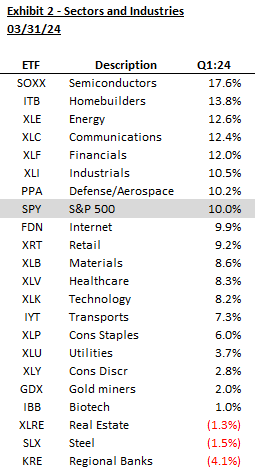
Let’s take a look at which types of stocks are driving the market in 2024 (Exhibit 2). Semiconductors were the best industry driven by insatiable demand for AI chips, mostly from Nvidia. Homebuilders did well too selling more homes while existing home inventory remains tight. Energy stocks rallied with strong oil prices as did communications – Meta, Google, and Disney in particular. Financials and industrial were strong as well with the economy avoiding the “landing” so far (hard or otherwise). Regional banks, steel stocks and real estate were the only areas with negative returns in Q1.
Digging a little deeper, Exhibit 3 shows the best and worst performing stocks in the S&P 500 during the quarter. The left section features top/bottom 5 names by dollar change in market value (and thus largest actual impact on the cap-weighted S&P 500 index). Nvidia, Microsoft, Meta, Amazon, and Eli Lilly collectively gained $2.2 trillion in market value, which accounts for 52% of the total index return. Apple and Tesla fell out of the market’s favor (at least for this quarter), while Adobe, Boing and UnitedHealth had various stock-specific issues and subtracted $692 billion from the index market cap.
The right section normalizes for the sheer company size and shows best/worst performers by percentage change in market value (as opposed to dollar change). Nvidia and Meta show up here too, while the other three companies are different. Similarly, Tesla and Boing make a repeat appearance but Charter, Humana and MarketAxess each dropped 25%.

Economy and Rates
For the past few months, we have seen tug of war between economic strength and rate cut expectations. The economy continues to surprise everyone by doing better than expected. That in turn causes people to re-think their expectations of when the Federal Reserve will cut interest rates.
The two most important economic numbers have been the number of jobs added each month and monthly inflation readings. Both have been higher than anyone expected a few months ago. On the employment front, the US has added between 250,000 and 300,000 jobs each month so far in 2024. My favorite gage of job market strength is year-over-year percentage growth in total jobs. It came in at 1.8%, 1.8%, and 1.9% for January, February, and March, respectively. As long as this number remains above 1.0%, there is very little chance of recession (and high decimal numbers with a 1% handle are extremely healthy). We are basically at full employment with adjusted labor force participation as high as it’s ever been. Notwithstanding the political controversy, the main reason the US is doing so much better than the rest of the world is immigration. Since the pandemic, native-born employment has stayed flat, and all of the job growth has come from foreign-born workers. (I have lots of charts on this but don’t want to clutter this note too much, let me know if you would like to see more details). Inflation has remained stubbornly high at 3.1% in January, 3.2% in February and then accelerating to 3.5% in March which surprised everyone leading to a big rate jump and market drop today.
The market has been constantly recalibrating rate cut expectations to later in the year on strong data and the resulting Fed comments. Year-end Fed-funds rate projection is now a full percent higher than it was in January (Exhibit 4). And so round and round we go with the market always trying to decide whether good news is good or bad.
